
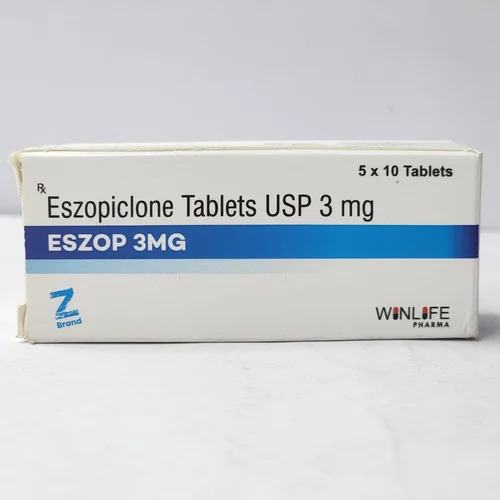
Description
Eszopiclone 3 mg Tablets: The Highest Strength, the Maximum Dose and the Risks to Understand First
Eszopiclone is a prescription sleeping tablet for short-term insomnia in adults. It is the active form of zopiclone, and it has recently become available in the UK as a licensed medicine. The 3 mg tablet is the highest strength and matches the maximum recommended dose, so it is the strength where next-day drowsiness and other risks matter most. For many people a lower strength is enough.
This guide explains who the 3 mg tablet is for, how to take it, and the safety points to know before the first dose. It is general education and does not replace your prescriber’s instructions or the patient leaflet.
Prescription-only medicine. Eszopiclone can only be supplied against a valid prescription from a licensed UK prescriber. Ask your pharmacist or the patient leaflet about its controlled-drug status. We cannot supply it without a valid prescription.
Eszopiclone 3 mg at a Glance
| Medicine | Eszopiclone (“Z-drug” hypnotic) |
|---|---|
| Strength | 3 mg per tablet (1 mg and 2 mg also exist) |
| Used for | Short-term treatment of insomnia in adults |
| Usual use | One tablet immediately before bed, only when you can have a full night’s sleep |
| Maximum dose | 3 mg in 24 hours; never more |
| Treatment length | As short as possible, usually no more than a few weeks including any dose reduction |
| Prescription required | Yes |
Where 3 mg Fits Among the Strengths
| Strength | Typical role |
|---|---|
| 1 mg | Lowest dose; often for people sensitive to sedatives |
| 2 mg | A common middle dose |
| 3 mg | The ceiling; used when lower doses have not worked and it is judged safe |
Prescribers aim for the lowest dose that works. The 3 mg tablet is not the starting point for most people, and it is generally not used for older adults or people with liver problems, who usually have a lower limit. Follow the dose on your label and the leaflet supplied with your own product, since details can differ between products.
How Eszopiclone Compares With Zopiclone
Zopiclone contains two mirror-image forms of the same molecule, and eszopiclone contains just one of them. They act on the same brain receptors and share the same main risks. The practical difference for you is the dose and the product your prescriber chooses. See our zopiclone 3.75 mg and zopiclone 7.5 mg pages for comparison. Never take both together or swap between them without advice.
Before You Rely on a Tablet
Clinical guidance recommends trying non-drug approaches first, and using sleeping tablets only when insomnia is severe and affecting daily life.
- Keep a regular bedtime and wake time
- Keep the bedroom dark, cool and quiet, and use it only for sleep
- Limit caffeine, especially after midday, and avoid heavy meals and screens close to bed
- Ask your GP about cognitive behavioural therapy for insomnia (CBT-I), which has the best long-term results
How to Take Eszopiclone 3 mg
- Take it immediately before getting into bed, not earlier.
- Only take it if you can stay in bed for a full night, about seven to eight hours.
- Swallow with water. Do not take it with or soon after a heavy meal, which can slow its effect, and never with alcohol.
- Take one tablet a night at most, and never repeat the dose if you wake in the night.
- Follow your prescriber’s plan for how many nights to use it.
Important Risks
Next-day drowsiness and driving
Eszopiclone can leave you drowsy, slow or unsteady the following day, even if you feel awake, and the risk is highest at the 3 mg dose. In the UK, driving while impaired by a medicine is an offence. Do not drive, cycle or use machinery unless you feel completely alert after a full night’s sleep. Official guidance is on the GOV.UK drug-driving page.
Complex sleep behaviours
Rarely, people taking medicines in this group have sleepwalked, eaten, made phone calls or even driven while not fully awake, with no memory of it. US regulators added a boxed warning for this, and anyone who has had such an episode on a sleeping tablet should not take it again. If it happens, stop the tablets and contact your doctor straight away.
Tolerance, dependence and withdrawal
Regular use can reduce the effect and lead to dependence, especially at the top dose or if you have a history of drug or alcohol problems. Stopping suddenly after regular use can cause rebound insomnia, anxiety and restlessness. Your prescriber will usually reduce the dose gradually.
Memory problems
Some people cannot recall events after taking the tablet. Going to bed straight away reduces this.
Low mood and thoughts of self-harm
Sleeping tablets can sometimes worsen low mood. If this happens, contact your doctor straight away. In an emergency call 999, or call Samaritans free on 116 123.
Breathing
Eszopiclone can slow breathing, especially with alcohol, opioids or other sedatives. If someone is very difficult to wake or breathing slowly or shallowly, call 999.
Common Side Effects
- An unpleasant or bitter taste in the mouth, the most typical effect
- Drowsiness or a hangover feeling
- Headache and dizziness
- Dry mouth
- Nausea or indigestion
- Vivid dreams
Alcohol and Other Medicines
Alcohol greatly increases sedation and breathing risk. Do not drink on a night you take it.
| Medicine | Concern |
|---|---|
| Opioid painkillers | Serious sedation and breathing risk |
| Benzodiazepines and other sleeping tablets | Added sedation; usually not combined |
| Pregabalin and gabapentin (see our pregabalin page) | Added drowsiness and breathing risk |
| Clarithromycin, ketoconazole, itraconazole and similar | Can raise eszopiclone levels; a lower dose may be needed |
| Rifampicin, carbamazepine, phenytoin, St John’s wort | May weaken the effect |
| Sedating antihistamines, antidepressants and antipsychotics | Increased drowsiness |
Who Should Not Take It
- People with myasthenia gravis
- People with severe sleep apnoea or severe breathing problems
- People with severe liver disease
- Anyone who has had a complex sleep behaviour episode on a sleeping tablet
- Anyone with a past allergic reaction to eszopiclone or zopiclone
- Pregnancy and breastfeeding: generally avoided; talk to your prescriber
- People with a history of drug or alcohol dependence, who usually need a different approach
Storage and Disposal
- Keep in the original pack at room temperature, out of sight and reach of children.
- Store securely.
- Return unused tablets to a pharmacy, and never give them to anyone else.
Frequently Asked Questions
Is 3 mg the maximum dose?
Yes. Do not take more than 3 mg in 24 hours. There is no 6 mg tablet.
Is eszopiclone stronger than zopiclone?
It is the active form of zopiclone, so doses are lower, but the effects and risks are similar. Do not treat the numbers as interchangeable.
Why does it leave a bitter taste?
Some of the medicine passes into saliva. It is common, not harmful and usually fades.
Can I drive the morning after?
Only if you feel completely alert after a full night’s sleep. If you feel drowsy or slow, do not drive.
Can I take it with alcohol?
No. Alcohol significantly increases drowsiness and breathing risks.
Can I stop it suddenly?
Not if you have taken it regularly. Reduce gradually with your prescriber’s guidance.
Can I buy eszopiclone without a prescription?
No. It must be supplied on a valid prescription from a UK prescriber.
Where to Read More
See the NHS insomnia pages, the GOV.UK drug-driving law page and the patient leaflet for the eszopiclone product you supply, available on the electronic medicines compendium.
Medical disclaimer: This information is for general education and does not replace advice from a qualified healthcare professional. Always follow your prescriber’s instructions and the patient leaflet supplied with your medicine.







Reviews
There are no reviews yet.