

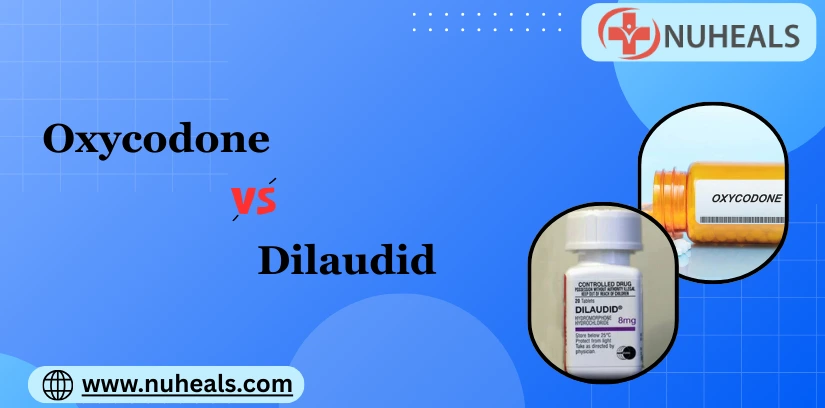
Oxycodone Vs Dilaudid both frequently appear in search lists of individuals, with curiosity instead of clear conclusions. Queries like Is Dilaudid stronger than Oxycodone? Highlight how people use to frame comparisons without having a full and clear definition. But in this introduction, we simply acknowledge interest, uncertainty, and differing viewpoints. Rather than providing specific details, outcomes, and claims, it recognises the continuing debate and the language frequently used around it. By focusing on tone and context, the topic is presented as a point of conversation.
Key Differences related to Oxycodone Vs Dilaudid
What are Oxycodone and Dilaudid?
Oxycodone: It is an opioid drug extremely used to manage moderate to unmanageable pain, a medicine extremely prescribed by doctors. By connecting to the opioid receptors, it starts its work on those that are there in the brain and spinal cord. Lessening the pain. It comes in two forms: immediate and extended release, which hold risks of dependence, overdose, abuse, and tolerance, and require medical supervision. Medication dosing needs to follow prescriptions, and patient monitoring is necessary all the time.
Dilaudid: It is a prescription-based opioid medication that is given by a doctor to treat pain. It is also known by its brand name, called hydromorphone. By connecting with the brain’s and nervous system’s opioid receptors, it minimizes the pain feelings. Respiratory depression, misuse, tolerance, and overdose are the threats that can arise because of Dilaudid’s quick action. To stay secure, it’s important to take the dosage with care.
How the Oxycodone Vs Dilaudid Medicines Act
Understanding the process of work of oxycodone and Dilaudid involves their action on opioid receptors to lessen pain perception. Oxycodone moderate to severe pain that commonly prescribed for a longer duration for many people. Dilaudid, known as hydromorphone, acts more rapidly and is frequently used in medical facilities. Discussions regarding Oxycodone vs Dilaudid potency and Oxycodone and Dilaudid strength indicate that Dilaudid is usually stronger. However, effectiveness differs regarding tolerance, condition, and formulation, making medical guidance needed for safe, individualised pain management choices. People monitoring and careful dosing help to maintain relief, side effects, and risks over time effectively over time.
Medical Uses of Both Medicine
Oxycodone vs Dilaudid: Medical Uses finds the way these prescription opioids are used to manage uncontrollable and intense pain in medical settings. When relating Oxycodone vs Dilaudid for pain, physicians consider pain severity, patient tolerance, and previous opioid use. For handling pain, doctors always prescribe Oxycodone. Dilaudid will be chosen when the case is severe. It’s common among people having doubts related to Oxycodone and Dilaudid together; basically, when combining two pain-related drugs, it increases the risk. People often ask, Can you take Oxycodone and Dilaudid together, This needs a proper medical direction, strict monitoring, and personalised treatment preparation to ensure safety.
Comparison Table: Oxycodone vs Dilaudid
| Feature | Oxycodone | Dilaudid |
| strength | Low Potency then Dilaudid | Roughly 3 to 5 times more powerful than Oxycodone |
| Time to act | Takes 15 to 30 minutes to start its action | It acts quickly after being taken |
| Half-life | It’s half time, up to 3 to 6 hours | It’s half time up to 2 hours |
| Main use | Moderate to uncontrollable chronic pain | Severe acute pain when other drugs failed to provide relief from pain |
| Formulations | Available in extended-release (ER) and Immediate-release (IR)tablets/capsules | Available in various forms: injection, tablet, and oral solution |
| Controlled ranking | Schedule II controlled substance. | Schedule II controlled substance. |
Side Effects Comparison of Both Drugs
As every medicine has some side effects, like that only two this has also there own side effects that may occur. Discuss with your doctor if you feel any of these symptoms given below:
- Basic side effects
Taking Oxycodone with Dilaudid can be a reason for constipation, nausea, vomiting and drowsiness, and this can be because both drugs act on the brain.
- Drowsiness and Sedation
A main difference between Oxycodone and Dilaudid is related to the potency. Dilaudid may bring mental clouding and deeper sedation as it is stronger than Oxycodone. Oxycodone in individuals who are taking other opioid drugs
- Respiratory Depression
Both drugs can be a reason for slow breathing, but this gets higher when it comes to Dilaudid because of its high potency.
- Risk related to Dependency
Dilaudid and Oxycodone carry the risk of addiction, tolerance, and dependence
- Mixing both drugs
Mixing Dilaudid with Oxycodone is risky and can cause you to suffer from respiratory depression, death, or coma. Avoid mixing unless suggested by the doctors.
Dilaudid and Oxycodone interaction
Dilaudid and Oxycodone taken together completely raise the risk and opioid effects. Oxycodone and Dilaudid are both strong opioid analgesics, but are Dilaudid and Oxycodone the same? No, both the drugs are different in power and dosing. Mixing them can amplify sedation and nausea, which can be fatal. People should avoid mixing them without medical supervision also should avoid alcohol. Always follow the prescriber’s guidelines.
Conclusion
In short, contrasting Oxycodone and Dilaudid to find which one is a safe and effective opioid for an individual’s needs first requires a medical checkup, pain, and medical history. Oxycodone is stronger and lasts for a long period. Dilaudid is more potent and usually taken for uncontrollable pain that other medicines have failed to treat. The aim is to maintain adequate painkillers with security, manage you, doge with care, and observe misuse.